
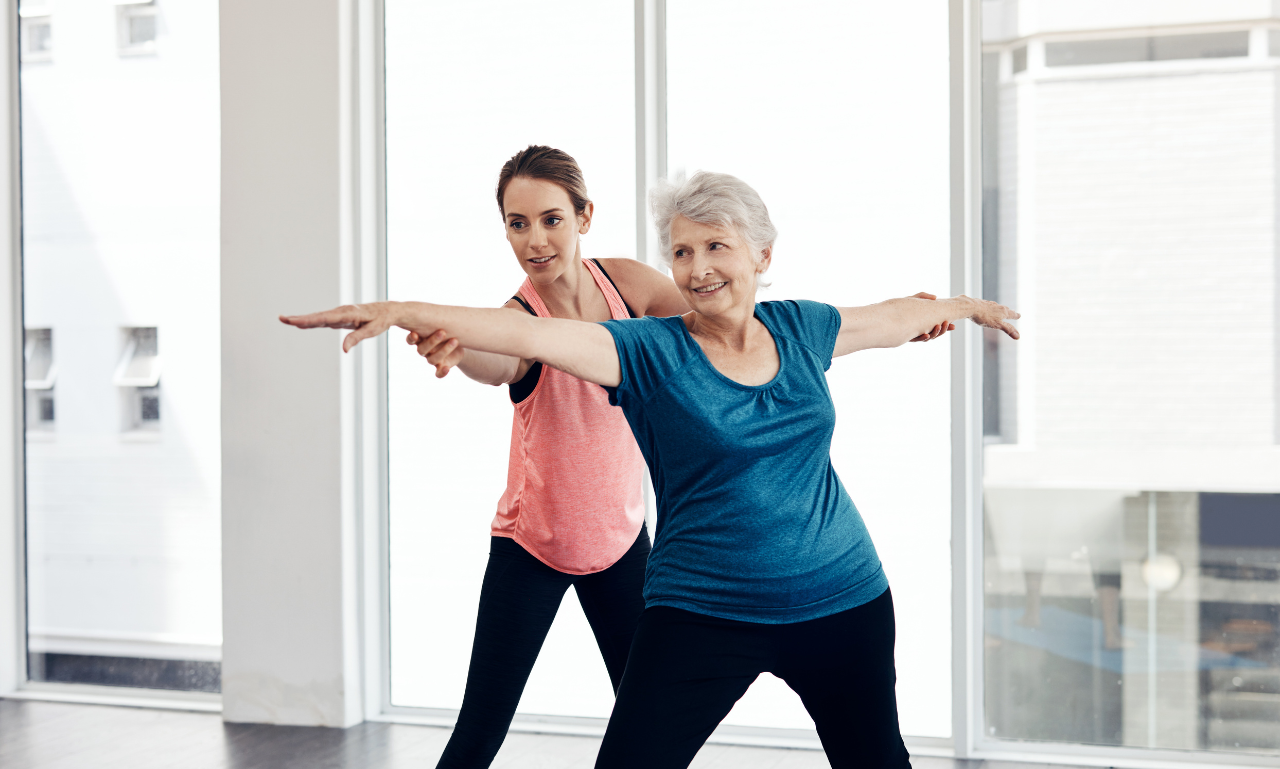
Standing on one leg often feels surprisingly difficult when someone has not challenged their balance for a while. After several weeks of regular physical activity, however, the same position may feel steadier even without practicing that exact movement every day. Balance improves with regular exercise because staying upright depends on trainable systems involving muscle strength, sensory information, coordination, joint control, and the nervous system’s ability to make rapid adjustments.
Balance Is an Active Process
A person who appears completely still is not actually motionless.
The body continually makes tiny corrections to keep its center of mass positioned over its base of support. Muscles around the ankles, knees, hips, trunk, and other areas adjust tension as weight shifts.
The brain coordinates those corrections using information from several sensory systems.
Vision provides information about the body’s position relative to the environment. Sensors in muscles and joints provide information about movement and position. The vestibular system in the inner ear contributes information about head movement and orientation.
Good balance emerges when the nervous system integrates these signals and produces an appropriate physical response.
Exercise can improve several parts of this process simultaneously.
Stronger Muscles Make Corrections Easier
Strength and balance are closely connected.
When the body begins moving away from a stable position, muscles must generate enough force to control or reverse that movement.
Weakness can limit this ability.
Lower-body strength is particularly important because the ankles, knees, and hips contribute substantially to maintaining posture during standing and movement.
The muscles of the trunk also help stabilize the torso while the limbs move.
Regular resistance training can improve the body’s capacity to produce and control force. Everyday activities such as climbing stairs, walking uphill, rising from a chair, and carrying loads can also challenge these muscles.
Strength alone does not guarantee excellent balance, but it gives the nervous system more physical capacity to act when a correction is needed.
Exercise Improves Proprioception
Closing your eyes does not immediately eliminate your awareness of where your arms and legs are positioned.
That internal sense is partly provided by proprioception.
Sensory receptors associated with muscles, tendons, joints, and other tissues send the nervous system information about body position and movement.
Proprioceptive information helps the brain determine how joints are positioned without relying entirely on vision.
Exercise repeatedly challenges this system.
Changing direction, shifting weight, landing, reaching, lifting, and moving across different surfaces require the brain to interpret sensory information and coordinate the body accordingly.
Over time, repeated exposure to these movements can improve the efficiency with which balance-related tasks are performed.
This is one reason activities involving controlled movement can produce benefits beyond simply increasing muscle size or cardiovascular fitness.
The Nervous System Learns Through Repetition
Exercise is also neurological training.
Every movement requires the brain and spinal cord to coordinate muscle activity.
When a movement is unfamiliar, control may initially be inefficient. The person can appear stiff, use unnecessary muscular effort, or make exaggerated corrections.
Practice changes that.
Repeated exposure allows the nervous system to become more familiar with the demands of the task. Movement can become smoother and more economical.
Balance develops similarly.
Someone learning a single-leg exercise may initially sway substantially. With practice, corrections often become smaller and more controlled.
The muscles have not necessarily transformed overnight. Part of the improvement reflects better coordination.
This neural adaptation explains why balance can begin improving relatively early in an exercise program, sometimes before large changes in muscular strength become visible.
Balance Improves With Regular Exercise Because Coordination Becomes More Precise
Muscles rarely work alone.
Maintaining stability requires groups of muscles to activate with appropriate timing and intensity.
Too little activation may fail to control movement. Too much can make the body unnecessarily rigid.
Regular exercise gives the nervous system opportunities to refine these patterns.
Consider stepping onto an uneven surface. The ankle must adapt while the knee and hip contribute to controlling the body’s movement. The trunk also needs to remain sufficiently stable.
These responses happen quickly.
Activities that involve varied movement provide repeated opportunities for different body regions to coordinate.
The result is not simply “stronger legs.” It is improved cooperation between sensory information, the nervous system, and muscular responses.
Ankle Control Plays a Major Role in Quiet Standing

Many small balance corrections begin near the ankles.
When someone sways slightly forward or backward while standing, muscles around the lower leg can adjust force to bring the body toward a more stable position.
This is sometimes described as an ankle strategy.
Exercise can strengthen these muscles while exposing the ankle to controlled changes in position and load.
Walking, resistance exercises, calf raises, and appropriate balance activities can all involve ankle control to varying degrees.
When instability becomes larger, however, the body may rely more heavily on movements around the hips or take a step to avoid falling.
Good balance therefore involves a collection of strategies rather than a single joint.
Regular physical activity can help maintain the capacity to use them appropriately.
Hip Strength Helps Control Larger Movements
The hips become particularly important when balance disturbances are too large to be managed through subtle ankle adjustments alone.
Muscles surrounding the pelvis help control the position of the legs and trunk.
They also contribute during walking, stair climbing, changing direction, and single-leg support.
Exercises such as appropriately performed squats, step-ups, lunges, and other lower-body movements can challenge hip control.
The exact exercises suitable for an individual depend on fitness level, mobility, injuries, and health circumstances.
For balance, the key benefit is not simply producing maximum force.
Muscles need to generate the right amount of force at the right moment.
Stronger and better-coordinated hip musculature can give the body additional options when stability is challenged.
Core Control Provides a Stable Center
“Core strength” is sometimes treated as though having strong abdominal muscles automatically creates perfect balance.
The reality is more nuanced.
The trunk contains multiple muscle groups that help control the spine, pelvis, and torso during movement. Their coordination contributes to maintaining an appropriate body position while the arms and legs move.
A stable trunk becomes particularly useful when carrying an object, reaching, turning, or changing direction.
Many exercises challenge this control without requiring specialized abdominal routines.
Walking, resistance training, loaded carries, controlled single-leg movements, and numerous recreational activities require the torso to respond to changing forces.
Improving trunk control can therefore support balance as part of a broader movement system rather than functioning as an isolated solution.
Vision Helps Stabilize the Body
Visual information provides powerful clues about orientation.
Looking at a stable object can make balancing easier because the brain has a consistent external reference.
Close the eyes and the task often becomes harder.
The body must rely more heavily on proprioceptive and vestibular information.
Some balance exercises deliberately change visual conditions to challenge this integration, but reducing visual input also increases difficulty and potentially the risk of falling.
It should therefore be approached cautiously.
Regular physical activity can expose the nervous system to different visual and movement conditions naturally. Walking outdoors, playing recreational sports, dancing, and navigating changing environments all require continuous integration between what the eyes see and what the body does.
Balance is partly the skill of combining these sources of information effectively.
The Inner Ear Contributes to Orientation
Inside the inner ear, the vestibular system helps detect head movement and orientation.
The brain combines this information with signals from vision and the rest of the body.
When these sources agree, maintaining orientation is relatively straightforward.
When information conflicts, balance can become more challenging.
Moving the head while walking, turning quickly, or changing direction requires the nervous system to continue integrating vestibular information while the body is in motion.
Regular activity can provide practice handling such movements.
However, persistent dizziness, vertigo, or unexplained balance problems should not simply be treated as evidence that someone needs more exercise.
Inner-ear disorders, medication effects, neurological conditions, cardiovascular issues, vision problems, and other medical factors can affect balance and may require professional assessment.
Walking Is More Balance-Intensive Than It Appears
Walking feels automatic to most healthy adults, but mechanically it involves repeated controlled instability.
For part of each step, much of the body’s weight is supported by one leg while the other moves forward.
The center of mass continually shifts.
The nervous system coordinates foot placement, muscle activity, visual information, and changes in the walking surface to keep the person moving without falling.
Regular walking therefore provides ongoing low-level balance practice.
More varied walking environments can increase the challenge because slopes, turns, obstacles, and different surfaces require additional adjustments.
This does not mean difficult terrain is appropriate for everyone.
Someone with substantial balance limitations may need a safer environment or professional guidance.
Still, ordinary locomotion demonstrates how closely movement and balance are connected.
Resistance Training Can Improve More Than Strength
Lifting weights is commonly associated with stronger muscles, but many resistance exercises also require substantial postural control.
A squat requires the body to control its center of mass as the hips and knees move.
A standing overhead press requires the trunk and lower body to stabilize while force is generated through the arms.
Single-leg exercises increase the balance challenge further.
Even machine-based resistance training can contribute indirectly by increasing the muscular capacity needed for daily movement.
The greatest balance benefit depends on exercise selection and individual needs.
A program combining strength development with tasks that require controlled posture and movement may address more components of balance than strength training alone.
Progression should remain appropriate because making an exercise unstable does not automatically make it more beneficial.
Dynamic Balance Matters in Everyday Life
Standing still is only one form of balance.
Daily activities depend heavily on dynamic balance: maintaining control while the body is moving.
Stepping off a curb, turning around, carrying groceries, climbing stairs, reaching for an object, or recovering after an unexpected trip all require stability during movement.
Exercise can train these abilities naturally.
Activities that involve controlled changes of direction, stepping patterns, reaching, or shifting weight force the body to manage a moving center of mass.
This is important because real-world falls rarely occur while someone is deliberately standing motionless in a perfect exercise position.
They often happen during transitions.
Training movement therefore complements exercises focused on static balance.
Reaction Speed Can Influence Recovery From a Misstep
Sometimes maintaining balance is not about preventing movement but responding quickly enough when something unexpected occurs.
A foot catches an uneven edge. A surface moves. Someone bumps into you.
The nervous system must detect the disturbance and organize a response.
That may involve rapidly activating muscles, moving the trunk, or taking a step.
Regular exercise can support several abilities involved in these responses, including strength, coordination, movement confidence, and task-specific reaction.
The extent of improvement depends on the activity.
A slow, predictable exercise routine and a sport involving frequent directional changes create different demands.
Neither is universally superior. The appropriate training depends on the person’s goals, abilities, and safety considerations.
Mobility Gives the Body More Ways to Correct Position
Balance also depends on having enough usable movement at important joints.
Restricted ankle mobility, for example, can limit certain strategies the body normally uses to keep its center of mass controlled.
The person may compensate elsewhere.
Regular movement can help maintain functional mobility, particularly when activities move joints through comfortable ranges.
However, flexibility by itself should not be confused with balance.
A person can be highly flexible and still lack strength or coordination.
Useful mobility combines an adequate range of motion with the ability to control that range.
Exercise can support both when programs include appropriate movement variety and strength through usable positions.
Fatigue Can Temporarily Make Balance Worse

Regular training can improve balance over time, but a difficult workout can temporarily have the opposite effect.
Fatigued muscles may produce force less effectively, while demanding exercise can reduce precision in movement control.
Someone who balances well at the beginning of a workout may become noticeably less steady near the end.
This is relevant when performing challenging balance exercises.
Activities with meaningful fall risk should not automatically be saved for the moment when someone is exhausted.
Fatigue also explains why balance can vary from day to day despite long-term improvement.
Sleep, illness, hydration, medication, previous activity, and general physical condition can influence performance.
Progress should therefore be judged across weeks rather than from one unusually good or bad session.
Balance Training Should Become Harder Gradually
The body adapts when it encounters an appropriate challenge.
A balance exercise that is initially difficult may eventually become easy.
At that point, some progression can be useful.
Difficulty can be changed by altering the base of support, movement pattern, surface, visual conditions, speed, or task complexity. Adding reaching or another controlled movement can also change the challenge.
Progression does not need to mean standing on extremely unstable equipment.
Exercises should remain safe enough to practice effectively.
For someone with a significant fall risk, having a stable support nearby or working with an appropriate health or exercise professional may be important.
The goal is controlled adaptation, not testing how close someone can come to falling.
Age Can Make Balance Training More Important
Several systems involved in balance can change with age.
Muscle strength may decline without sufficient activity. Reaction speed can change, sensory information may become less precise, and vision or vestibular function can also be affected.
These changes do not mean poor balance is inevitable.
Regular physical activity can help maintain strength and movement capacity, while balance-specific exercises can provide practice for the systems responsible for postural control.
For older adults, this can have practical importance because falls can lead to significant injuries.
Exercise programs may therefore combine resistance training, balance work, walking, and other appropriate activities.
Individual circumstances matter greatly. Someone with previous falls, significant weakness, dizziness, or medical conditions may benefit from professional assessment before beginning challenging exercises.
Different Activities Train Balance in Different Ways
There is no single exercise that owns the concept of balance.
Strength training develops force capacity and control. Walking provides repeated dynamic stability practice. Dance can challenge timing, direction changes, and coordination. Yoga and similar practices may involve controlled postures and transitions. Some sports demand rapid responses to unpredictable movement.
Each emphasizes different aspects of the system.
The most useful activity is often one that can be performed consistently, safely, and at an appropriate level of difficulty.
Variety can also help because everyday balance does not occur under one standardized condition.
The body must manage different surfaces, positions, speeds, and sensory environments.
Training that exposes it to a reasonable range of movement challenges can build a broader foundation.
Improvement Depends on Consistency
Balance adaptations require repeated exposure.
One demanding session cannot replace weeks of practice.
Fortunately, balance-related training does not always require lengthy dedicated workouts. Many strength exercises, walking activities, recreational movements, and brief balance tasks already challenge the relevant systems.
Consistency gives the nervous system repeated opportunities to refine movement while allowing muscles to become stronger.
Progress may first appear in subtle ways.
There may be less wobbling during an exercise, smoother direction changes, greater confidence on stairs, or fewer unnecessary movements while standing on one leg.
These changes represent improved control rather than simply the ability to hold a particular pose for a longer time.
Conclusion
Stability is not created by one muscle or one sense. It emerges from continuous communication among the brain, eyes, inner ear, muscles, joints, and the environment, with corrections occurring so quickly that most people never consciously notice them.
That interconnected system explains why balance improves with regular exercise. Stronger muscles provide more capacity to control movement, repeated practice improves coordination, and varied activity teaches the nervous system to interpret sensory information while making increasingly efficient adjustments. Dynamic movement adds another layer by practicing stability during the kinds of transitions encountered in everyday life.
Improvement does not require turning every workout into an unstable balancing challenge. Consistent strength, movement, and appropriately progressive balance practice can train the underlying abilities over time. Persistent or unexplained balance problems, however, deserve appropriate medical evaluation because exercise is only one factor influencing the body’s ability to remain upright.
Also Read: How Do Hospitals Train AI Systems Without Violating Patient Privacy?
FAQs
The timeline varies with age, starting ability, training frequency, and the type of exercise, but improvements can develop progressively with consistent practice.
Yes. Walking repeatedly challenges dynamic balance, coordination, leg strength, and control of the body’s center of mass.
It can be. Stronger lower-body and trunk muscles provide greater capacity to control movement and recover from changes in position.
Persistent, sudden, worsening, or unexplained balance problems—especially those accompanied by dizziness, weakness, fainting, vision changes, or neurological symptoms—should be assessed by an appropriate healthcare professional.
