
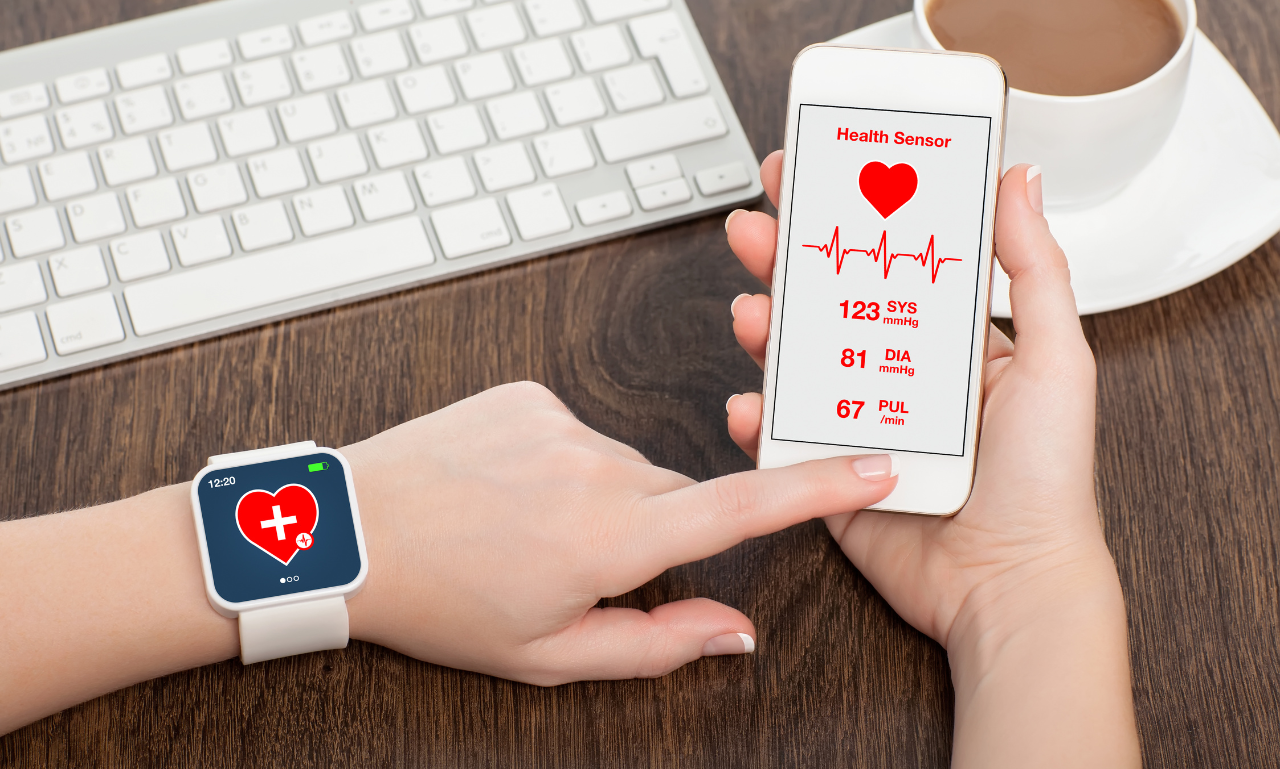
Two health apps can receive information from the same health apps and show different trends of the day. One might report seven hours of sleep while another records less, or one may describe activity as moderate while another presents the day as unusually active. The disagreement does not necessarily mean that one application is malfunctioning. Raw sensor measurements have to be interpreted, and different systems can make different decisions about what those measurements represent.
Wearables Measure Signals Rather Than Most Health Outcomes Directly
A wearable device contains sensors capable of detecting particular physical signals.
An accelerometer can measure movement. An optical sensor can detect changes associated with blood flow. GPS can estimate location and movement outdoors. Other devices may measure temperature-related signals, electrical activity, or environmental information.
Many of the numbers shown in health apps are not direct sensor readings.
Sleep duration, calories burned, stress estimates, recovery scores, activity intensity, and similar metrics usually require algorithms to transform sensor information into something understandable.
The distinction is important.
Two applications can begin with similar measurements but use different rules to interpret them.
Health Apps Can Show Different Trends Because Algorithms Differ
Algorithms determine how raw measurements are converted into categories and estimates.
Consider movement.
One application may classify a certain pattern as walking, while another requires a different duration or intensity before recording it as a walk.
The same principle can apply to sleep.
An app must decide when the user probably fell asleep, when they woke, and whether periods of movement during the night represent wakefulness.
Those decisions depend on models, thresholds, and assumptions.
Companies generally develop their own methods, which means identical input data does not guarantee identical output.
Data Sources May Not Actually Be Identical
Two applications displayed on the same phone may appear to use the same wearable information while relying on slightly different data streams.
One might read information directly from the device manufacturer’s platform.
Another could access summarized data through a phone’s health-data framework.
A third may combine wearable measurements with information entered manually.
The timing of synchronization can also differ.
If one application has received the latest data and another has not, their dashboards can temporarily disagree.
Before comparing algorithms, it helps to determine whether both applications are genuinely working from the same underlying records.
Sleep Is Particularly Difficult to Estimate
Consumer wearables usually cannot observe sleep in the same way as a full clinical sleep assessment.
Instead, they infer sleep from signals such as movement, heart-related measurements, and other available data.
This creates several interpretation challenges.
A person lying still while awake can resemble sleep to an algorithm.
Someone who moves during sleep can create the opposite problem.
Different apps may also use different definitions for time in bed and actual sleep time.
One may count a brief awakening differently from another.
As a result, two sleep summaries can diverge even when both are processing reasonable interpretations of the available signals.
Sleep Stages Add Another Layer of Estimation
Some wearables divide sleep into categories such as light, deep, and REM sleep.
These outputs can look precise because they are presented in minutes and charts.
Precision of presentation should not be confused with direct observation.
The application is estimating sleep stages from the signals its hardware can collect.
Different manufacturers can use different models and training data.
Consequently, stage estimates may vary substantially between systems.
For everyday users, broader patterns—such as consistently short sleep or changing sleep schedules—may sometimes be more informative than treating every minute assigned to a particular stage as exact.
Step Counts Depend on Classification Rules
Counting steps sounds simpler than estimating sleep, but it still involves interpretation.
A wearable detects movement rather than literally watching feet touch the ground.
The algorithm must determine which motion patterns represent steps.
Everyday activities complicate this process.
Moving the arms while stationary can sometimes resemble walking-related motion. Walking while pushing a cart can reduce normal arm movement. Device placement can alter the signals being recorded.
Manufacturers tune their systems to reduce false positives and missed steps.
Because those rules differ, step totals from two devices or applications do not always match exactly.
Distance Can Be Calculated in Several Ways
Walking and running distance may come from GPS, estimated stride length, step counts, or combinations of these sources.
GPS can work well outdoors when reception is suitable, but buildings, trees, tunnels, and other conditions can affect positioning.
Indoor activity may rely more heavily on estimated stride length.
If two applications make different assumptions about stride, filtering, or GPS quality, they can report different distances for the same activity.
Calibration can improve estimates on some devices, but users should still expect some variation.
A displayed distance is the result of a measurement process rather than an infallible record.
Calorie Estimates Depend on Models
Wearables do not directly count the calories a person burns.
They estimate energy expenditure.
The calculation may incorporate movement, heart-related data, age, body size, sex-related profile information, activity type, and other variables available to the system.
Different models can assign different energy costs to the same activity.
This makes calorie estimates especially likely to vary between applications.
Even small differences in how resting energy expenditure or exercise intensity is calculated can produce noticeably different daily totals.
For this reason, comparing calorie numbers across platforms requires caution.
Heart Rate Data Can Be Filtered Differently

A wearable may collect many heart-rate-related measurements throughout the day.
The number displayed by an application may depend on which measurements it selects and how it summarizes them.
One app might emphasize a daily average.
Another might report resting heart rate calculated during particular low-activity periods.
A third could define resting heart rate using sleep-related measurements.
Even if the underlying readings are similar, the summaries need not match.
Signal-quality filtering also matters.
Applications may discard measurements they consider unreliable, and different systems may make different decisions about which readings to exclude.
Resting Heart Rate Is Not Always Defined Identically
The phrase “resting heart rate” sounds standardized in ordinary conversation, but consumer platforms can calculate it differently.
Should it represent the lowest sustained value during the day?
An average during periods when movement is minimal?
A value derived partly from sleep?
The answer depends on the system.
This means someone switching platforms might notice a change in their reported resting heart rate without experiencing an equivalent physiological change.
Comparisons are most useful when the measurement method remains consistent.
Long-term trends within one system can sometimes be easier to interpret than direct comparisons between platforms using different definitions.
Activity Minutes Depend on Thresholds
Many health applications classify periods of movement according to intensity.
A brisk walk may count toward moderate activity.
A slower walk may not.
Where exactly is the boundary?
The answer depends on the application’s rules.
Some systems rely heavily on movement. Others incorporate heart-rate response or activity classification.
A user walking for 40 minutes might therefore receive 40 active minutes in one application and fewer in another.
Neither number describes the activity independently of the algorithm.
It describes how the activity matched that platform’s definition.
Workouts May Be Detected Automatically
Automatic workout detection adds another source of variation.
A wearable might identify sustained movement and ask whether the user is exercising.
Another platform may require the activity to continue for a minimum period before recording it.
Some systems automatically recognize walking or running more readily than strength training or other activities.
If a workout is manually started, the application receives a clear signal about when exercise began.
Without that input, the software has to infer the event.
Differences in automatic detection can therefore create different exercise histories even when the physical activity was identical.
Missing Data Can Change the Daily Summary
Wearables do not collect perfect continuous records.
The device may be removed for charging.
A sensor can temporarily lose good contact with the skin.
The battery can run out.
Synchronization can fail.
Permissions can change.
When information is missing, applications have choices.
One may leave the period blank.
Another may estimate certain values.
A third may use information from the phone or another connected device.
The resulting daily totals can differ because the applications handled the same gap differently.
Checking for missing periods is useful before assuming that a trend represents a genuine physical change.
Duplicate Records Can Create the Opposite Problem
Connected health ecosystems often contain several potential data sources.
A phone records steps.
A watch records steps.
A fitness application writes activity information into a shared health platform.
Another application imports it.
Without appropriate source prioritization or deduplication, the possibility of overlapping records arises.
Modern platforms attempt to manage these relationships, but configuration matters.
Users who connect many applications should understand which source is considered authoritative for important metrics.
A sudden increase in activity data may occasionally reflect a synchronization or source issue rather than a dramatic change in behavior.
Time Zones Can Distort Daily Comparisons
Health dashboards organize continuous activity into calendar days.
Travel complicates those boundaries.
A person crossing time zones can experience an unusually long or short calendar day.
Sleep may begin in one time zone and end in another.
Workouts recorded near midnight can appear on different dates depending on how the application handles local time.
These effects can make travel periods look strange in otherwise stable trends.
The underlying activity still occurred.
The disagreement comes from how continuous events were divided into daily reporting periods.
Different Apps Smooth Trends Differently
Daily measurements fluctuate naturally.
To make patterns easier to see, applications may calculate moving averages or compare recent values with a personal baseline.
The chosen window matters.
A seven-day average responds to changes differently from a 30-day average.
An application emphasizing recent measurements may show a trend quickly.
Another using a longer baseline may describe the same change as relatively minor.
Neither presentation necessarily alters the original measurements.
The difference comes from how those measurements are summarized over time.
This is particularly important when users compare trend arrows, warnings, or status labels across platforms.
Personal Baselines Can Produce Different Interpretations
Some digital-health systems compare users primarily with population-level ranges.
Others place greater emphasis on the individual’s previous measurements.
A value can therefore be ordinary relative to a broad population but unusual for a particular person.
This affects how apps communicate changes.
One may present a measurement as normal.
Another may highlight it because it differs from the user’s recent baseline.
These approaches answer slightly different questions.
Population comparisons ask how a measurement relates to other people or general reference information.
Personal baselines ask how today’s measurement relates to the individual’s own history.
Software Updates Can Change Historical Comparisons
Health applications are not static.
Developers revise algorithms, fix errors, add features, and change how measurements are interpreted.
A software update can therefore alter the way new data is calculated.
In some systems, historical information may also be reprocessed.
This creates an important consideration for long-term tracking.
A sudden change in a graph might coincide with a software or device update rather than a major change in the user’s behavior or physiology.
When an unexpected trend appears, checking whether the app, wearable firmware, or measurement method recently changed can provide useful context.
Consistency Often Matters More Than Agreement Between Apps
Suppose one application consistently reports slightly more sleep than another.
The difference may be frustrating, but it does not automatically make trend tracking useless.
If each system applies its own method consistently, both might still detect a meaningful change when the user’s routine shifts.
This is one reason long-term comparisons are often easier when the same device and application are used consistently.
Switching platforms can create a break in the measurement series.
A new baseline may be more useful than trying to force exact equivalence between systems built around different algorithms.
Wearable Numbers Need Context
Digital-health dashboards make complex measurements easy to view.
That convenience can encourage users to treat each number as a definitive judgment.
A single unusual result often deserves context.
Was the device worn correctly? Perhaps the user was traveling. Could some data have been missing?
Did exercise occur unusually late?
Did the software update?
Was the person ill?
Is the measurement part of a continuing pattern or an isolated result?
Looking at trends alongside circumstances helps prevent overinterpretation of ordinary measurement noise.
The more consequential the conclusion, the more important it becomes to consider how the number was produced.
Consumer Data Is Not Automatically a Clinical Diagnosis
Wearables can provide useful information about behavior and physiological patterns, but consumer metrics vary in purpose and validation.
A dashboard label should not automatically be treated as a medical diagnosis.
This is particularly important when an application estimates complex states from indirect signals.
Persistent symptoms or concerning changes deserve attention based on the broader situation, not solely because an app generated a particular score.
When health decisions depend on a measurement, discussing relevant data with an appropriate healthcare professional can help clarify whether additional assessment is warranted.
Digital tracking is most useful when its capabilities and limitations are both understood.
Conclusion
The neat numbers on a health dashboard are the final stage of a much larger process. Sensors collect signals, software filters them, algorithms classify patterns, and applications decide how those results should be summarized for the user.
Health Apps Can Show Different Trends without either application necessarily being defective. Differences in data sources, thresholds, sleep definitions, calorie models, activity classifications, missing-data handling, baselines, and averaging methods can all change what appears on the screen.
For everyday tracking, consistency can be more informative than forcing several platforms to agree exactly. Using the same measurement system over time, watching broader patterns, and investigating unexpected changes in context can make wearable information easier to interpret. The numbers may look precise, but understanding where they came from remains an important part of understanding what they mean.
Also Read: Daily Readiness Scores Turn Sensor Data Into an Estimate, Not a Verdict
FAQs
They may use different movement-classification rules, data sources, device priorities, or methods for filtering movements that do not represent actual steps.
Accuracy depends on the metric, device, algorithm, and circumstances. A platform that performs well for one measurement may not necessarily be best for every other measurement.
Software updates can modify algorithms, filtering, classifications, or the way information is summarized, potentially changing reported values.
Consumer wearable information can provide useful context, but it should not automatically replace appropriate clinical assessment when symptoms or significant health concerns are involved.
